
Common Instructional Framework
MRC Instructional Framework
The Framework for Improving Student Outcomes (FISO) is the unifying framework for improvement in Victorian schools. The FISO uses contemporary school improvement and school effectiveness research to help schools focus their efforts on key areas that are known to have the greatest impact on improved student outcomes.
The MRC Instructional Framework is underpinned by the FISO model, with a focus on students at the centre of all teaching, learning and pedagogical improvement.
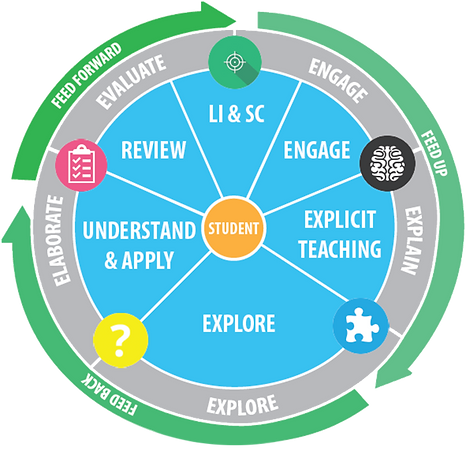

How does the MRC Instructional Framework compare to other models?
LEARNING SEQUENCE

students should be doing
TEACHER should be doing
Learning Intention and
Success Criteria
-
Articulating and creating the learning goals of the lesson
-
Developing key questions relevant to the LI & SC
-
Identifying and defining keywords and unknown words from the LI & SC
-
Making connections to prior learning and the real world
Engage
-
Actively participating in the designated ‘Do Now’ task
-
Articulating links between do now task and lesson focus
Learning Intention and
Success Criteria
-
Introduce goals / set goals for the lesson
-
Prompting connections to prior learning and context
-
Identifying the lesson purpose within the unit/lesson sequence
Engage
-
Provide a short accessible task for students to begin the lesson
-
Collecting observational/anecdotal data to inform lesson progression
-
Supporting engagement of off task and challenging students
Explicit Teaching
-
Actively listening to teacher instruction
-
Processing new key knowledge
Explore
-
Ask questions and seek clarification on new knowledge and skills
-
Working independently/ collaboratively to build understanding (we do)
-
Connect prior knowledge with new key skills
-
Investigating and experimenting with new skills and concepts
Explicit Teaching
-
Deliver new knowledge
-
Model skills ('I do' phase)
-
Explicitly highlight and create links/connections to prior learning
Explore
-
Support students to generate and investigate questions
-
Model/co-construct worked examples with students ('we do')
-
Differentiate levels of instruction / activities according to student needs
-
Probe / prompt and/or clarify student understanding through questioning or discussion
-
Collecting observation and informative data
-
Provide links to concepts taught in the explicit teaching phase
Understand & Apply
-
Record evidence / demonstrate new learning
-
Apply new skills and knowledge to a task ('you do')
-
Ask clarifying questions
-
Seek and apply feedback
-
Apply new concepts to previous or prior learning
Review
-
Critically evaluate performance with reference to learning intention and success criteria
-
Set goals for future learning
Understand & Apply
-
Roam classroom and conference as required ('you do')
-
Provide differentiated learning opportunities/ tasks and level of scaffolding (extension and support)
-
Provide feedback on the completion of student tasks
-
Probe and unpack level of student understanding
-
Collect formative / summative evidence and data
Review
-
Revise learning intention and success criteria
-
Address misconceptions/ gaps in learning
-
Make connections to future learning opportunities
-
Acknowledge learning successes and progress